Kim Caspare’s 2024 Olympic Experience with the Gold Medal Winning USA Men’s Basketball Team
As summer comes to an end, PHIT Well’s Co-Founder, Kim Caspare, reflects on her 2024 Paris Olympic experience with the Gold Medal winning USA basketball team.
Even as she was awed by the talent, teamwork and dedication of the USA Men’s Basketball team—and not just the players—she felt at home with the best of the best.

Q: How did you end up in Paris with the USA Men’s Basketball team?
Kim: I’ve been working with Joel Embiid for nine years.
Joel missed his first two seasons with a broken bone in his foot. I started working with him during what would have been his second season, and worked with him for almost a year before he could play—and I was there for the first night he set foot on the court wearing his 76ers jersey.
Officially I’m his “Performance Physical Therapist,” but for most basketball people who know us, I am his “everything” person—devising and overseeing his strength and conditioning exercises, and any needed rehab—all of which changes depending on what’s going on with Joel’s body.

During our time together, Joel’s been the NBA’s Most Valuable Player (2023) and finished second twice (2021, 2022).
It’s been a dream of Joel’s to play in the Olympics. A few years into Joel’s career, Joel damaged the meniscus in his left knee and needed surgery. Then last year, more than halfway through the NBA season—just after he’d scored 70 points in one game, and was averaging 36 points a game—Joel reinjured his left knee, and again needed surgery.
Even though the operation was in February, Joel was determined to make it back for the playoffs, and also to play for the United States at the Olympics.
We worked together to make that happen. He returned for the playoffs against the Knicks, and even scored 50 points in Game-3, but he still wasn’t 100%. So, Joel and the 76ers asked me to travel with him and Team USA for their qualifying games, and then onto Paris, and work with Joel designing and implementing his next stage of rehab and strengthening at the Olympics.
Q: You’ve worked a lot with world class athletes, but suddenly you were working with a team of 12 of the greatest basketball players in the world—
Kim: I’ve got to interrupt you. Because I’m also working with the greatest coach in the world in Steve Kerr—he’s won nine NBA Championships! He’s won four coaching the Warriors, and five as a player (three playing with Michael Jordan, and two with Tim Duncan).

He’s won four coaching the Warriors, and five as a player (three playing with Michael Jordan, and two with Tim Duncan).
And Steve’s Olympic assistants were Erik Spoelstra, Tyronn Lue and Mark Few, all three of them amazing coaches. I mean, Erik’s won three NBA championships, and Ty’s won one championship as a coach and two as a player. These guys are the best at what they do.
Q: And suddenly you are working with a team of 12 of the greatest basketball players and greatest coaches in the world, in a tournament that features the greatest basketball players from around the globe—and you’re in Paris, at the Olympics.
Kim: The whole thing was so heightened. Everything was so maximized. You’re with the best players in the world, the best coaches in the world, and the best trainers and physical therapists in the world. I learned so much about myself during the experience. It was a transformative experience.
Q: How so?
Kim: Leading up to the Olympics—through USA Basketball’s training camp and exhibition games—was a massively complicated experience, because Joel was coming off a knee surgery, and had gone straight into the NBA playoffs, so his rehab was different than if he’d had the full off-season to rehab his knee.
With the Olympics coming up so quickly after the playoffs, we had to manage his playing time, so Joel would not reinjure a newly rehabilitated knee post surgery.
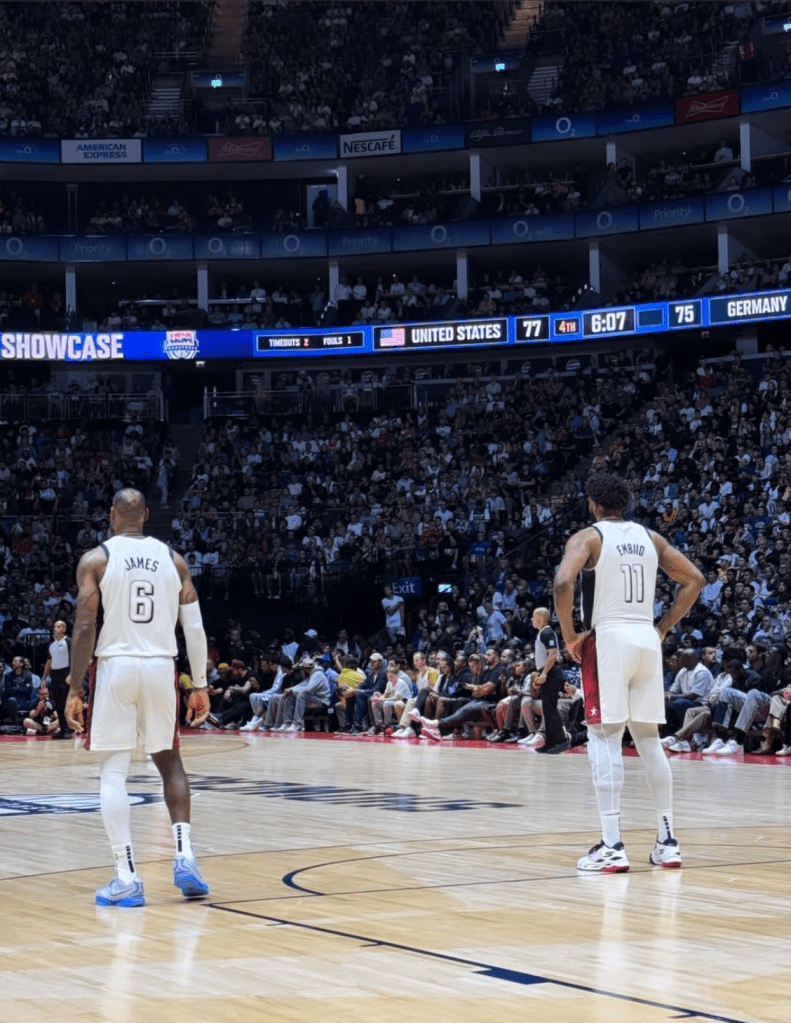
Steve Kerr and Grant Hill (head of USA Basketball) knew they needed Joel’s big body—especially against Serbia and Nikola Jokić, who was last season’s NBA MVP and also the league MVP the two seasons before Joel won it—but I was worried about Joel over-training and over-playing, and reinjuring his knee. So, once the playoffs ended for the 76ers, I re-evaluated everything, calculated the data points for everything I could measure and observe, and then built out a 12-week “return to play” plan, taking us all the way to the Gold Medal game.
This meant that I had to control Joel’s minutes from the start of the Olympic training camp through the exhibition games and through the Olympics. Steve Kerr and the coaches were supportive, but I had to build a case and continue proving that my strategy was the right strategy, and that being cautious was in the best interest of Joel and the team .

Q: So… You were in charge of Joel’s minutes?
Kim: Joel knows his body—he knows how he feels—but he’s a great competitor, so he always wants to play as much as he can. That’s why he came back so quickly to be in the NBA playoffs.
Look, there aren’t a lot of world class athletes who if you ask them, “Are you okay to play the full game?” are going to answer you with, “No, I’ve only got 12-minutes in me.”

Steve and Grant trusted me. They knew I’d been working with Joel for five seasons, and that I was the one working with him on his rehab. They knew that I know Joel’s body. I can see and feel things that they can’t. More importantly, I can see and feel and measure things that Joel can’t, because he’s such a competitor.
All my patients, whether they’re athletes or not, know the feeling of thinking you can do more than you can, or should.
And so do I. I went to college as a swimmer. And I injured my shoulder and wasn’t given the kind of guidance that my staff and I give our patients and clients at PHIT Well. Heck, anybody reading this who’s worked with a great physical therapist knows that they can see and even feel things about your body that you can’t.
That’s what makes a great physical therapist—it’s not just the empathy of feeling and saying, “I’m sorry you’re hurt.” That’s sympathy. Real empathy at PHIT Well is, “I feel your pain.”

Photo Credit: Sam Limon
As a physical therapist, you have to be both passionate—you have to love what you’re doing, and really care about your patients—and dispassionate—you have to be able to say, “Sorry, you’re not ready, yet. We’ll get there, but you’re not there yet.”
And that’s what happened with Steve Kerr.
Steve would ask me, “How much can Joel go?” And I had to say, he’s got “this many minutes.” I knew being over conservative would be the only way to truly avoid a set back that we couldn’t afford in the runway we had leading up to the gold medal game.
Do I think he could have gone more, yes, but I wasn’t willing to compromise.
Q: And what did that feel like?
Kim: On the one hand it was difficult, because of course Joel just wanted to play. And there were games where Steve or Erik would look at me, and ask me, “Can he go more?” And I’d have to say, “No. He’s done.” And I knew Joel wanted to play more.
Q: How did you know?
Kim: Oh, I knew. I could see it. And (laughs) I could hear it.
Q: Steve Kerr and Erik Spoelstra are treating you as an equal. What was that like?
Kim: They were amazing. It was a shot of confidence like I’ve never felt before.
And, remember: This is at the Olympics! The USA team was the overwhelming favorite, so the pressure was intense. The entire world expects us to win every single game! Everybody feels that pressure. But what was amazing is how everyone dealt with it.
What was amazing was being at all the practices and watching the players come together as a team. And also watching the coaches learn about the players, and the different on-court player combinations.
I could see—and I could quickly feel—how being the best at what you do at the Olympic Games comes with a real sense of responsibility.
I always want to be my best. Always. And I hope all of my clients know that. But to have Steve Kerr and Erik Spoelstra and Grant Hill trust me with a key part of their chance to lead Team USA to a Gold Medal—with all the pressure that they were under—that was one of the greatest honors of my life.
Q: What did you learn watching the players about greatness and leadership?
Kim: LeBron James is a flat-out leader. He was present, in the moment, and engaged every second. On and off the court there was never a minute LeBron wasn’t engaged. He was engaged in the dining room talking to people. He was engaged walking to the bus. He was engaged on the bus. He was engaged on the court at practice. He was always talking with the guys about game situations and what they could do. He could have been exhausted, tired, but he never looked tired.
LeBron started each game like a bullet out of his pen. He has a presence, it was just incredible to see up close—especially at the practices. In practices and games, he always knows what’s going on. He’s always aware of the game situation. And he’s always aware of his teammates.

Q: Aside from the memories, what did you bring back from Paris?
Kim: We’ve been talking about the coaches and players, but the other physical therapists and trainers who were there, they’re also Gold Medal material—they’re all the best in the world. And they were all confident that they were the best at what they do. They knew that they were there for a reason—but they also knew that it was much bigger than just them.
Watching Steph Curry work out with Carl Bergstrom, you could see how in sync they were. They did these incredible functional movement exercises—Steph moves through space while being tethered to Carl with an elastic band—and Carl would be moving and hitting Steph, as Steph was trying to move through his patterns. It was this wonderful, unchoreographed dance. It was as if Ginger Rogers and Fred Astaire were dancing, and one of them was trying to push the other off balance, as part of the dance.
Jru Holiday’s chiropractor is a mastermind, the way he manipulates Jru’s body to do what he needs it to do. Amazing.
Every single person that I met and spoke with on Team USA knew that they belonged at the Olympics. And I found that to be very intoxicating. I was like, “Okay, let’s bring it.”
I learned from them, and I hope they learned a little from me.
Most of all, I brought back a sense of excitement about how I could employ what I saw and experienced back into my practice at PHIT Well.

I really do consider us a Gold Medal team.
My role here—along with working with my patients and clients—is to be a teacher. I’m an educator. I’m a lifelong student, and the Olympics were a Master Class, but I’m an educator, and I want to raise the level of everyone who works for me.
I want the best of the best to come to PHIT Well. And I know that they’re not going to stay static. Every physical therapist and trainer that comes through my door, if they’re really good, if they want to be great, they’re on their own remarkable journey.
The people that I want here are the people that have incredibly high aspirations. So I tell them to think of this as a two year program. They have to be great to work here, and they do great work while they’re here, but the very best won’t be satisfied staying here. I know that and I promise them that if they perform at a Gold Medal level at PHIT Well that I will be there to coach them along the way:
I’ll work with them on their skill sets—and, of course, I’m learning from them, too—and I’ll also teach them about how to navigate clients, players, coaches, team executives—all while they’re working to advance their expertise in whatever they want to be an expert in—whether it’s fascial manipulation, whether it’s strength and conditioning, whether it’s creating programs that optimize recovery and performance.
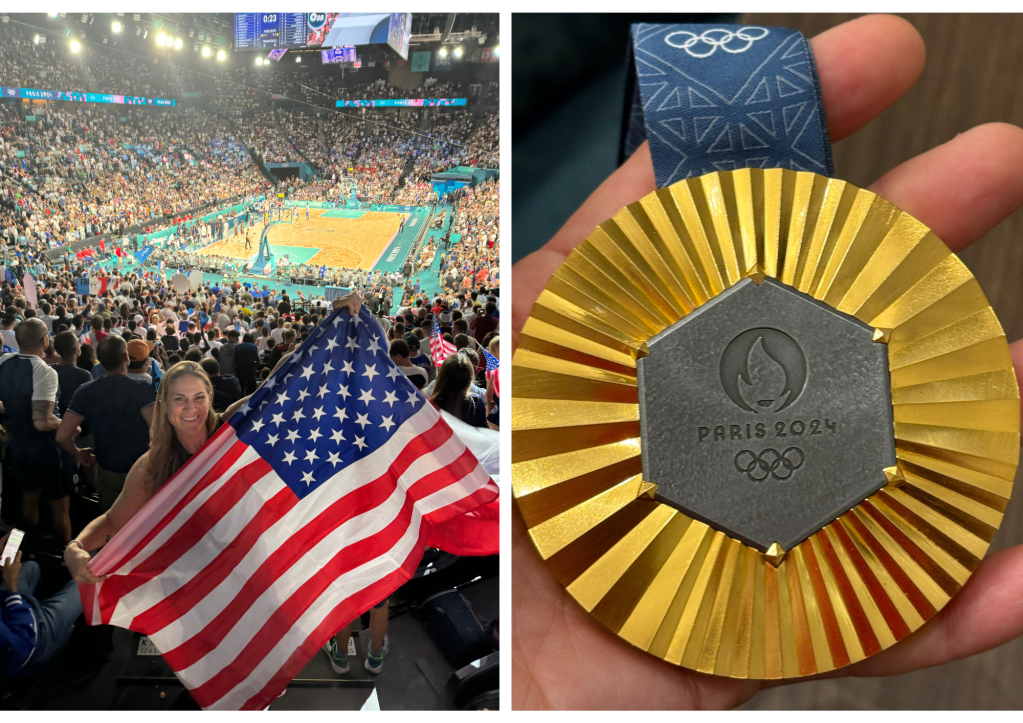
You know, at the Olympics only the players get Gold Medals. The coaches don’t get them. And the trainers and physical therapists certainly don’t. It’s not like Super Bowl rings, where everyone in the organization gets one. But I truly feel like I came back with a Gold Medal.
My Gold Medal is a different level of confidence. And a deeper understanding of greatness. And, especially thanks to Steve and Erik, it’s also a deeper understanding of how to coach the best of the best.
And that’s what I came back to at PHIT Well. The best of the best.
 Kimberly J Caspare